
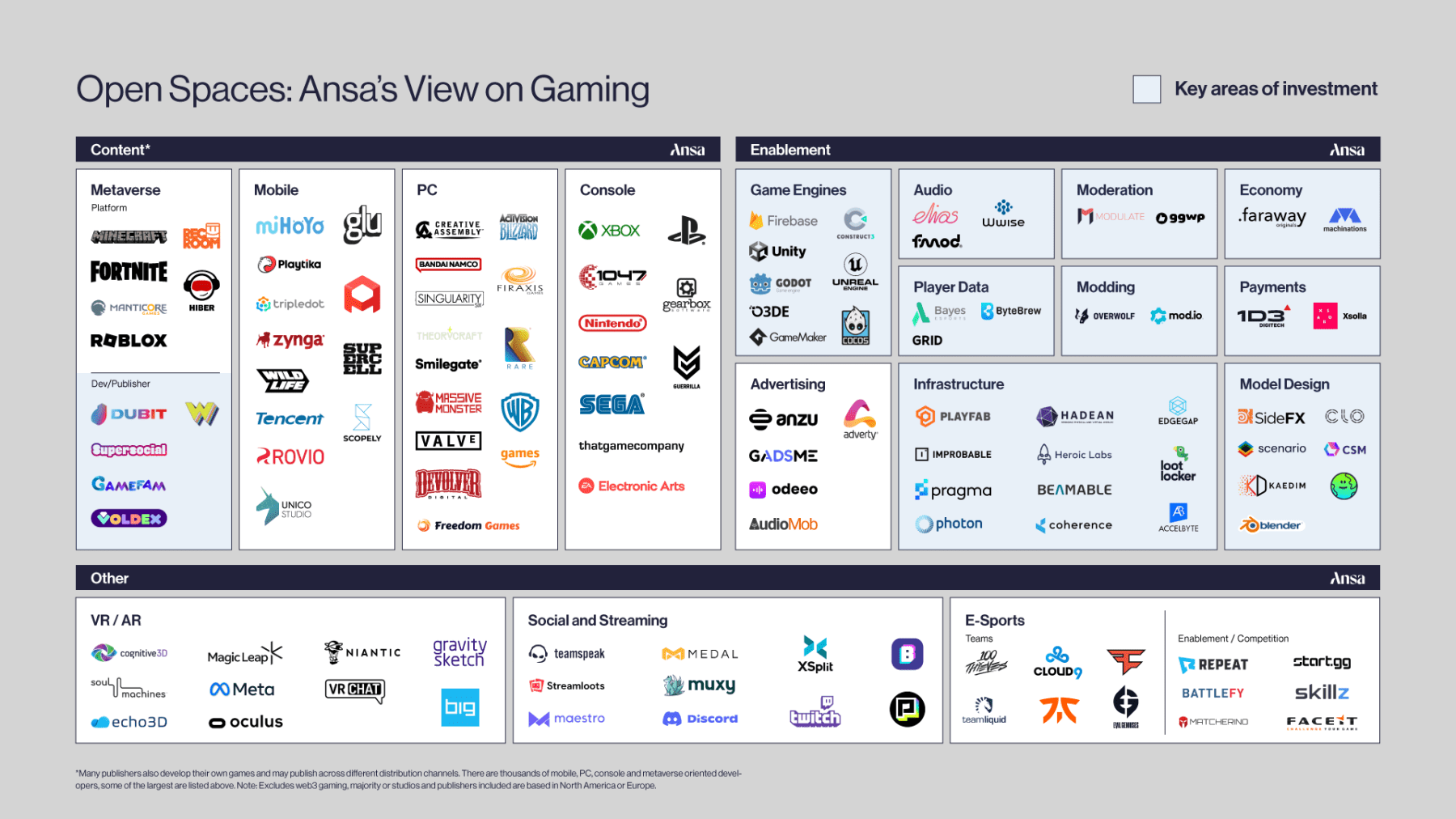
So, the last time we wrote about gaming, Duncan was deep in Baldur’s Gate. Weeks later, after we pulled him out and got him some sleep, it felt like time to share our market map on the space. Building upon our team’s recent Open Spaces [our signature series of white paper-style articles exploring our thesis areas], we’re introducing our Gaming Market Map – which highlights our partnership’s views on the gaming industry’s rapidly changing face, spanning content, enablement, social, streaming, and much more.
The top 3 questions we get from gaming CEOs we meet when considering an investment are:
- What is our in-house POV on the gaming universe?
- Where are we actively investing in the category?
- Why should an entrepreneur in this space work with Ansa?
This post touches on each, and we hope it shows we’re not just observing the ecosystem – we’re behind the scenes in partnership with founders helping to define it.
Introducing our Gaming Market Map:
As we’ve started to invest in the gaming renaissance, we distilled this landscape into a couple of pivotal areas we’re focused on.
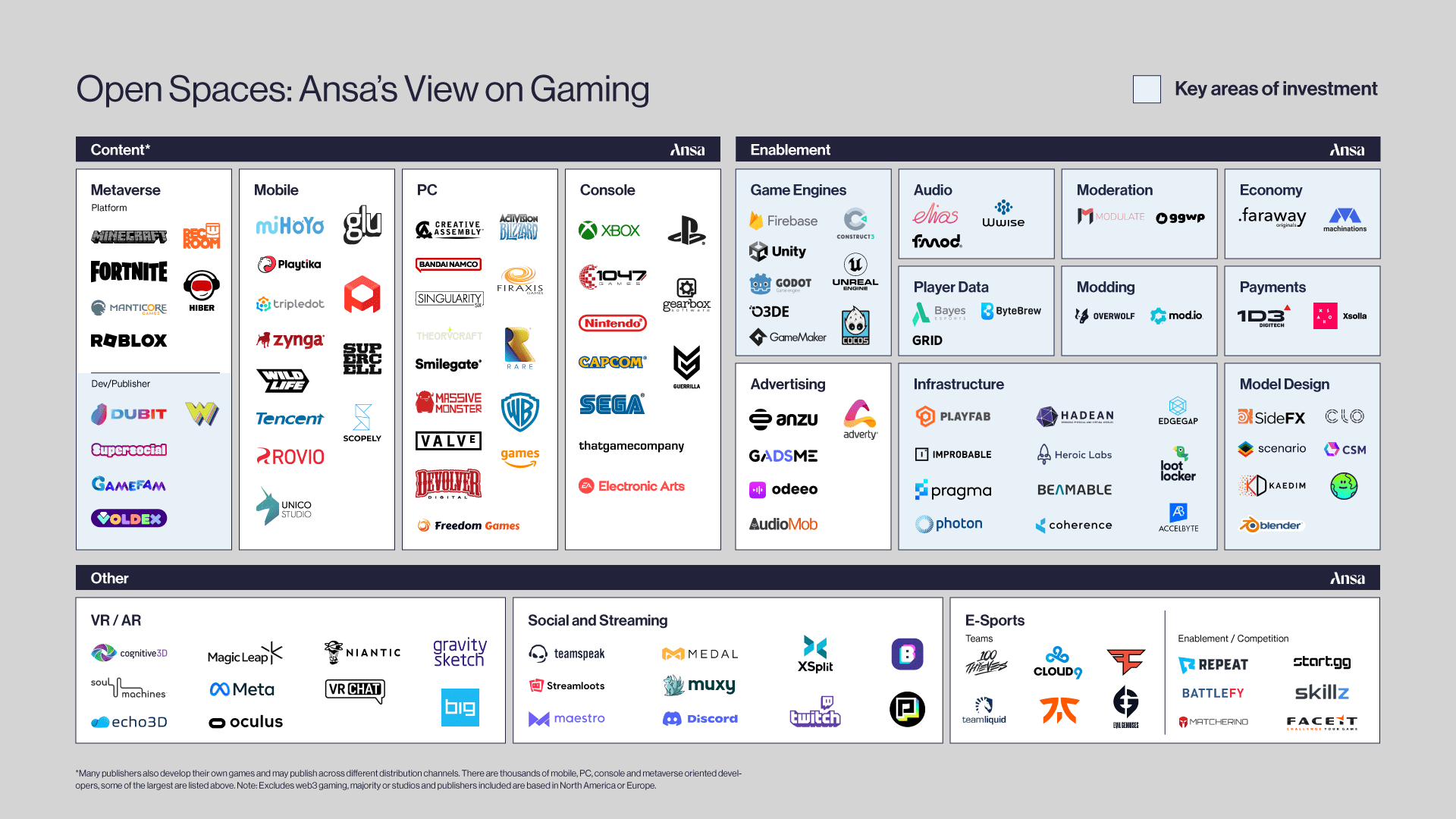
Content
Content is the lifeblood of gaming, which is why we invest in this space. When we back a business in this space, we go beyond supporting their in-house development infrastructure. We also help them draw game content from three other channels – Hollywood IP licensing, third-party publishing, and M&A. Similarly, we know ourselves well enough to know who we’re not for – we don’t back AAA studios pre-launch, for example, and have no interest in competing with Xbox for a title launch on their console. Instead, when we work with publishers, we prefer to build platforms that enable an edge outside of capital or content, ideally, in a net-new ecosystem. In certain cases, we aggressively pursue partnerships, license quality IP, and supplement 1st-party game development with 3rd party publishing.
For a management team, these capabilities are an unlock we’re quite proud of.
As a partnership, we aren’t prescriptive on the “what.” From action-packed RPGs to immersive virtual worlds, we believe there is something for everyone and aren’t in the business of simply checking boxes. That said, we’re excited to see studios and developers are not only pushing the boundaries of storytelling, graphics, and gameplay but also championing inclusivity and representation. We’ll always have a soft spot for content as gamers ourselves.
Enablement
The largest area of investment focus for us has been the enablement layer, which we define as software tools targeted at key areas of game development. As consumers and publishers demand more complex games on tighter timelines, developers require software tools to drive speed in the development process independent of adding incremental headcount. Historically, developers would try to accomplish this by stitching together homegrown or open-source tools built for short-term wins (e.g., a single game) instead of long-term usage. The entrepreneurs who resonate the most with us have recognized that this is a clear opportunity to drive value for studios, publishers, and the gaming community via commercial software tools.
It only takes looking at a game like Among Us to understand the power that efficient game creation can have. A studio of four people created the game. In under a year, they developed and launched multiplayer mode and grew to over 3.8 million concurrent users at peak. Our mission is to back tools that can enable rapid development and growth, and we are actively investing in this space.
Within this ‘modularization’ of game development, we are actively pursuing new investments in the following areas:
- Moderation: A few minutes on a losing team in any League of Legends or Overwatch ranked lobby can rattle even seasoned gamers. Tools that can help moderate not only competitive games but the large group of games targeting younger segments of the population will only get more critical as people spend more time online. One only has to look to last week, when Roblox acquired Speechly, to see how high a priority moderation is to teams.
- Economy Management & Player Data: As games continue to transition to recurring revenue business models (almost every top-grossing mobile game is freemium), there has been an increased focus on the value of player retention and monetization.
- Modding: It doesn’t take long to find a hugely popular game originating from a mod (League of Legends, CS: GO, PUBG). We see modding as not only a key avenue to new game loop creation and a path to game longevity but as an interest of a growing young group of players who have started their gaming careers on platforms like Roblox.
- Infrastructure: Multiplayer games are inherently difficult and expensive to build, and the backend networking and infrastructure to support player interaction quickly can become complex. Infrastructure tools are a necessity to produce multiplayer games efficiently both in development and as they scale.
- Model Design: Game asset creation can take up significant chunks of game development budgets. We see early traction in reducing model design and creation workflows through technological advancements like generative AI and other workflow-oriented tools that can reduce manual processes in asset creation.
As a firm, we’re hyper-focused on investing in these areas. We believe in the silent forces powering unforgettable gaming moments: the software products and technological foundations necessary to serve both gamers and developers at scale.
These products are not just the gears in the gaming machinery; they are key businesses in democratizing game creation, ensuring that aspiring developers and studios have access to the resources they need. Ansa has built strategic relationships with studio execs to help drive revenue to businesses we back in the space, as the majority of them focus on publishers and platforms we’re close to (after all, why else hire someone who worked at PlayStation ;)).
If you’re building in the space, are post-monetization, and are exploring raising a Series A through C in the months to come, don’t hesitate to reach out to Marco DeMeireles, marco@ansa.co, and Duncan McGillivary, duncan@ansa.co. We’d love to explore partnering with you.
By Marco DeMeireles and Duncan McGillivary
The gaming industry is undergoing a radical transformation. With over 3 billion players as of 2023, the future of gaming has arrived, and it’s shaping up to be more awe-inspiring and boundary-breaking than ever before.
Fueling this rapid growth is the development of new game engines and development tools that make it easier for anyone to create a game, the rise of crowdfunding platforms that allow developers to raise money for their projects, and the growth of digital distribution platforms that amplify game accessibility.
At Ansa, we believe that the companies that evolve from upstarts to household names are the ones that take advantage of “open spaces” — opportunities that emerge as consumer behaviors shift, distribution channels evolve, and markets take shape. The gaming industry is a prime example of this changing landscape and one of the key focus areas for our team.
Below, we’re outlining some trends leading to some of the most exciting — and investable — openings, from demographic shifts to new tech tools.
Everyone is now a Gamer
Within this transformation, a new population of gamers has bloomed. Constituting a formidable 48% of the player base, women have emerged as a potent force within the gaming domain, and the archetypal gamer is also older than you might think. People over 65 devote more time to gaming than those between 35 and 64. This expansion in the player base presents an opportunity, as the landscape is ripe for studios and platforms to reach a broader range of players.
Yet, while the landscape flourishes with diversity, women remain underserved. Despite their significant presence, they are often alienated by the content and marketing of games, which are typically male-oriented. 71% of mothers now play video games, signaling an untapped demand for puzzle-style games, such as the universally adored Candy Crush.
While there have been strides in recent years, with characters like Angrboda from God of War: Ragnarok and Sojourn from Overwatch, too few games feature diverse characters and stories. This lack of inclusion can be alienating for players of color. The future beckons to champions of creative narratives, ready to carve the path toward more comprehensive and inclusive digital realities. Our focus on new markets at Ansa draws us to opportunities that support underserved communities, and we get excited about platforms that can draw in new players.
Farewell to the Traditional Storefront
The traditional channels of distributing games through physical stores and digital marketplaces are quickly becoming outdated as new distribution channels emerge. One of the most promising new distribution channels is games within games. Rather than going directly to Steam or the Microsoft store to find that content, hundreds of millions of players find games they want within the ecosystems where they are already playing. Players can encounter captivating content within the realms they already inhabit. This model can potentially reach a larger audience of players while leveraging IP in a similar way to the early days of mobile.
At Ansa, our ethos is entwined with cultivating pioneering startups within nascent ecosystems. We seek out first movers who can profitably bring high-quality IP and content and rapidly scale using their best practices. We’re also thinking about the future of premium IP. Where will WWE be taken next? How can we bring the world of Harry Potter to life in a new and innovative way? These questions fuel us as we dive into gaming’s tomorrow.
Next-Gen Developer Tools are Here
As games have become more complex, studios have sought solutions to eliminate manual, time-consuming, and expensive game development processes (such as building standalone backends, moderation tools, and economy management platforms). This has led to a broader ecosystem of gaming-oriented development tools, including asset creation and management platforms, back-end management, moderation, and game economy management.
Just as many companies license their game engines today, many studios of tomorrow will choose pre-built solutions for their development stacks. The next generation of tools is still being developed as founders embrace and implement technologies like generative AI to enhance gameplay experiences. The deployment of generative AI and innovative technologies signals a new frontier of seamless gameplay experiences, a terrain we at Ansa invest in ardently.
The Democratization of Game Creation
New technologies allow for a low barrier to entry, as anyone can create and publish games, regardless of their budget or experience. Platforms like Unity and games like Among Us have scaled swiftly despite smaller teams. The viral social deduction game was developed by Innersloth, at the time a team of three, before eventually scaling to hundreds of millions of downloads and over $86M in lifetime revenue by June 2021 (source). GameMaker and Roblox’s native game design tools allow for even more accessible game creation, empowering less technical users.
We expect that game creation will continue to see democratization over time, leading to new gameplay loops, viral games, and ways to play without requiring the capital intensity of large AAA games. We get excited by studios and publishers that can leverage the next generation of these tools, combined with innovative game loops and world-class teams.
Looking Ahead
Spending time with operators and founders in this space has shown us the industry is in flux, with uncharted territories and untapped potential. The themes discussed in this blog post are just a few ways gaming is changing. As the industry continues to grow, innovation and creativity will converge, beckoning pioneers to sculpt the future of gaming.
To the creators and visionaries building the next generation of games and gaming tools, please get in touch. We love having these conversations. Ansa primarily invests $5-30M into post-monetization startups at the forefront of gaming’s bright and promising future. Are you already on the path to constructing this very future? If so, we eagerly encourage you to connect with Marco DeMeireles, marco@ansa.co, and Duncan McGillivary, duncan@ansa.co.
 LateralThinking.vc